Monsieur McKennaTeacher of French Il vaut mieux faire que dire. -Alfred de Musset“Doing is better than saying.” Email: mckennaj@lcmrschools.com | Phone: (609) 884-3475LCMR School District - 687 Route 9, Cape May, NJ 08204 |

| HOME | French I | Foreign Language for Everyone | French Club | Links |
Unité 4 Le monde personnel et familier
Leçon 12: La voiture de Roger
OBJECTIVES
NOTE Culturelle Les Français et la voiture France is one of the leading producers of automobiles in the world. The two automakers, Renaultand Peugeot-Citroën, manufacture a variety of models ranging from sports cars to mini-vans and buses. To obtain a driver’s license (un permis de conduire) in France, you must be eighteen years old and pass a very difficult driving test. French teenagers can, however, begin to drive at the age of sixteen, as long as they take lessons at an accredited driving school (auto-école) and are accompanied by an adult. Lessons in these schools are expensive and it may cost you 300 euros before you pass the exam and get your official license. The French driver’s license is a permis à points (license with points). A new license carries with it 12 points. When a driver commits a traffic violation, such as speeding or not wearing a seat belt, a corresponding number of points is subtracted from the license. If a driver loses all 12 points, the license is revoked and that person can no longer drive.
A. Les couleurs De quelle couleur … ? What color … ? —De quelle couleur est la moto?
blanc noir bleu rouge jaune vert gris marron orange rose → The colors orange and marron are INVARIABLE. They do not take any endings.
B. La place des adjectifs avant le nom Compare the position of the adjectives in the following sentences.
A few adjectives like petit and beau come BEFORE the noun they modify. →The article des often becomes de before an adjective. Compare:
VOCABULAIRE Les adjectifs qui précèdent le nom beau (belle) beautiful, handsome Regarde la belle voiture! →There is a LIAISON after the above adjectives when the noun which follows begins with a vowel sound. Note that in liaison:
VOCABULAIRE Expressions pour la conversation → How to get someone’s attention: Dis! Say! Hey! Dis, Éric, est-ce que tu as une voiture?
C. Il est ou c’est? When describing a person or thing, French speakers use two different constructions, il est (elle est) and c’est.
→ Note the corresponding plural forms:
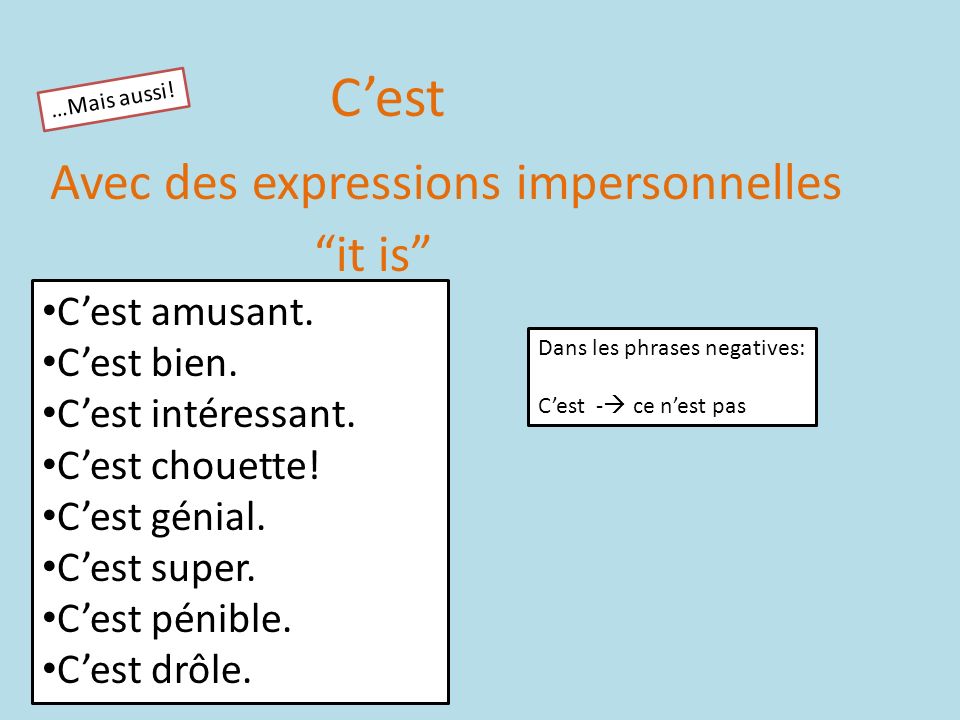
→ In negative sentences, c’est becomes ce n’est pas.
→ C’est is also used with names of people
D. Les expressions impersonnelles avec c’est
VOCABULAIRE Opinions
→ To express an opinion, French speakers also use adverbs like bien and mal.
Prononciation Les lettres «ch» The letters “ch” are usually pronounced like the English “sh.” Répétez: chien chat chose marche
Vidéo ActivitésVidéo Activités Worksheet
Audio Activités Worksheet
Les devoirs (homework)
Quiz 12 Script
Unité 4 - TEST (A) Audio Script
|